

Introduction
Next-Generation High-Throughput Targeted Lipidomics (6K Panel)
Our newly upgraded 6K High-Throughput Targeted Lipid Quantification service is powered by the ultra-high-performance Sciex 7500+ Mass Spectrometer. This advanced platform provides comprehensive coverage and precise detection of 53 lipid subclasses and nearly 7,000 distinct lipid molecules.
The quantification workflow integrates over 80 stable isotope-labeled internal standards. By applying a one-to-one correction for each target lipid molecule, this approach fundamentally eliminates potential errors arising from matrix effects and instrumental fluctuations. This ensures:
◉ High Accuracy: Precise qualitative identification of lipid molecules.
◉ Reliability: Stable and robust quantitative results.
◉ Physiological Relevance: A comprehensive restoration of the in vivo lipid metabolic landscape.
This solution delivers solid, data-driven support to empower your research and applications in lipid metabolism.
Technical Advantages
◉ Doubling of Lipid Coverage: The number of quantifiable lipids has surged from 3,200+ to 6,500+, representing a 103% increase! Every lipid category undergoes rigorous experimental validation and data calibration. Key parameters—including lipid structural information, retention time, and isotope-labeled internal standards—are provided for each molecule, laying a solid foundation for accurate qualitative and quantitative analysis.
◉ Significant Expansion of Lipid Classes: Lipid subclasses have expanded from 35 to 53, a 48% increase! We now include critical biological subclasses such as Sphingosine-1-phosphate (S1P), Ceramide-1-phosphate (CerP), Monosialodihexosylganglioside (GM3), and Coenzyme Q. This expanded panel meets diverse analytical needs across samples from animals, plants, and other sources.
◉ Optimized Sample Workflow: Lipid extraction protocols and acquisition parameters have been specifically optimized for various sample types, including clinical, plant, and microbial specimens. These improvements significantly reduce false positives and false negatives, ensuring higher data fidelity.
◉ Rigorous Quality Control (QC): A multi-layered QC system has been established. By utilizing isotope-labeled internal standards and dedicated QC samples, we monitor sample stability throughout the detection process, greatly enhancing data reliability and reproducibility.
◉ Comprehensive Annotation: We integrate rich annotation data from multiple authoritative sources, including LipidBlast ID, LIPID MAPS ID, PubChem ID, HMDB ID, KEGG ID, and InChIKey. This ensures that every detected lipid is fully traceable and searchable, facilitating downstream biological interpretation.
Sample Requirement
Tissue | 60mg/sample |
Plasma/Serum | 60ul/sample |
Urine | 60ul/sample |
Stool | 50mg/sample |
Cell/Bacteria | 1*10^7/sample |
LC-MS Platform
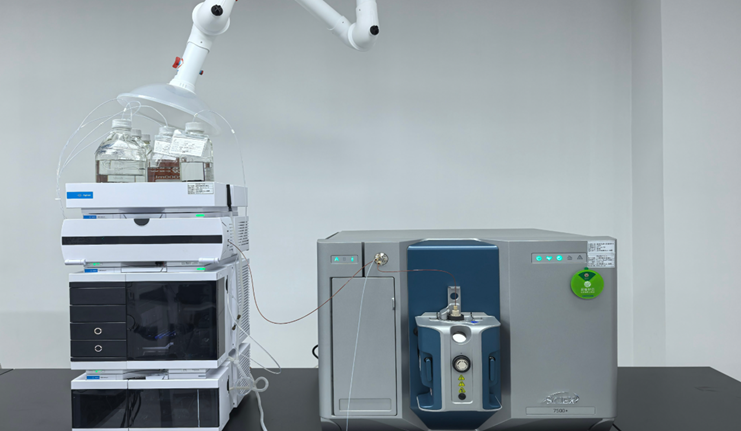
Triple Quad 7500+, Sciex
Applications
◉ Clinical Diseases: Biomarker Discovery, Disease Subtyping, Therapeutic Monitoring
◉ Traditional Chinese Medicine (TCM): Quality Control, Mechanism of Action, Toxicity Evaluation
◉ Pharmaceuticals: Drug Development, Efficacy Assessment, Pharmacokinetics (PK)
◉ Food Science: Processing Optimization, Geographic Origin Tracing, Nutritional Analysis
◉ Animal Husbandry: Scientific Feeding, Developmental Studies
◉ Agriculture: Breeding, GMO Research, Pesticide Development
Example Publication
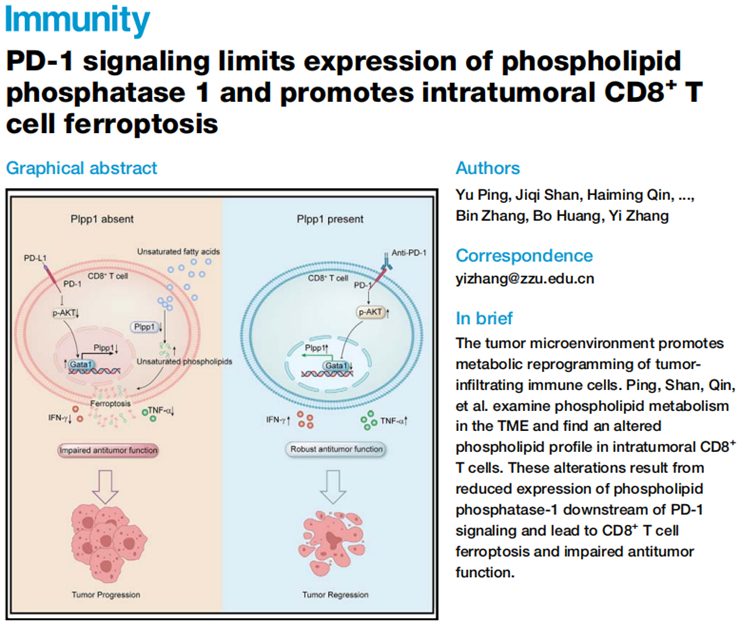
Title: PD-1 Signaling Limits Phospholipid Phosphatase 1 (PLPP1) Expression and Promotes Ferroptosis of Intratumoral CD8+ T Cells
Journal: Immunity
Impact Factor: 26.3
Key Findings: This study provides the first characterization of the lipid metabolic state of tumor-infiltrating CD8+ T cells under conditions of PLPP1-mediated aberrant phospholipid synthesis. We elucidate a novel mechanism wherein reduced PLPP1 levels in these T cells lead to an accumulation of unsaturated phospholipids, triggering ferroptosis and consequently impairing anti-tumor function. These findings offer a new perspective on understanding T cell dysfunction within the tumor microenvironment.
Furthermore, we demonstrate that PLPP1 downregulation is primarily driven by PD-1 pathway activation. Crucially, high PLPP1 expression correlates with enhanced efficacy of anti-PD-1 monoclonal antibody therapy. Therefore, strategies to upregulate PLPP1 expression in T cells represent a promising new therapeutic target and avenue for improving the outcomes of cancer immunotherapy.
