

Flavor substances are mainly Volatile organic compounds (VOCs), usually refers to the atmospheric pressure, boiling point at 50℃-260℃ of all kinds of organic compounds. VOCs can be further divided into alanes, aromatic hydrocarbons, esters, aldehydes and others according to their chemical structure. Common benzene, toluene, xylene, styrene, phenyl ethanol, chloroform, propyl butyrate, 2-nonone, 2-octanone and so on.
Technical Advantage
Various kinds of detection: Based on hS-GC-MS platform and solid phase microextraction technology can detect a variety of volatile substances;
Experienced in sample pretreatment: can handle all kinds of tissue and cell samples;
Professional data analysis: professional data processing and analysis software, data can be PCA, OPLS-DA, T-test and other analysis.
technical specification
Sample Requirements
Plant tissue 200-500 mg/sample
Animal and clinical tissue 200 mg/sample
Serum plasma 200 μL/sample
Microbial cell 1 ×10⁷ cells/sample
Biological repetition
Number of samples: plant and microbial samples n 6, animal samples N 10, clinical samples n 30, all duplicate samples are analyzed independently other types of samples please contact company sales engineer before collection
testing platform
Solid Phase Microextraction +HS-GC/MS (Aglient 7890B-5977B)
Regular project cycle
Experimental testing :20 working days (from the date of receiving the advance payment and sample)
Data analysis :5 working days
Application direction
Identification of volatile metabolites
Analysis of aroma components of fruits
Ambient air detection
Volatile biomarker discovery
Case Analysis
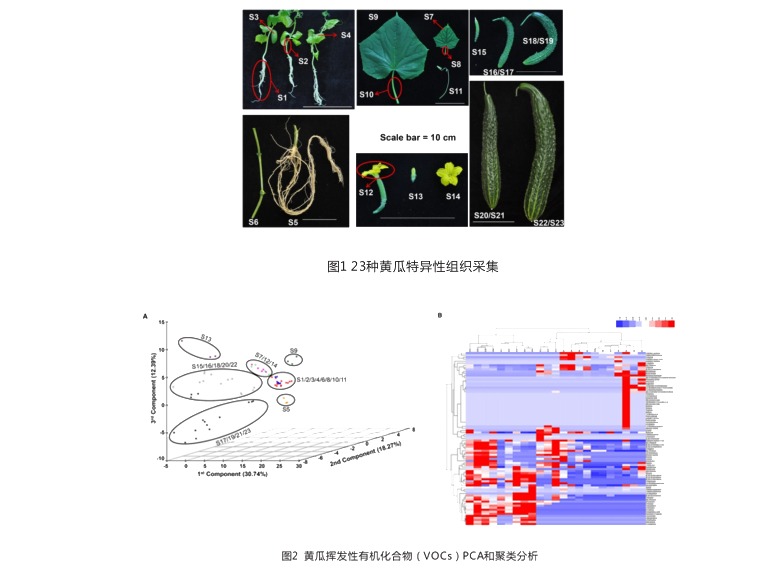
Study on tissue-specific molecular mechanism of Volatile organic Compounds (VOCs) in Cucumber。
Plant Volatile organic compounds (VOCs), with tissue specificity, can protect plants from various forms of biological attack, and play an important ecological role in the ecological environment. Currently, more than 1700 volatile compounds have been found in plants Cucumber is loved by people for its rich nutritional value and refreshing taste. In this study, 23 different cucumber tissues were detected and 85 volatile compounds were identified. At the same time, combined with transcriptome analysis, the biosynthesis pathway and regulatory molecular mechanism of cucumber volatile organic compounds were systematically revealed
Wei G, Tian P, Zhang F, et al. Integrative Analyses of Non-targeted Volatile Profiling and Transcriptome Data Provide Molecular Insight into VOC Diversity in Cucumber Plants (Cucumis sativus L.)[J]. Plant Physiology, 2016, 172(1):603-618.
